

Smoke and Mirrors
"Nothing has a stronger influence psychologically on their children
than the unlived life of the parent.”
– Carl Jung

Don't Bury Me
The sun still shimmers on the horizon, painting golden strips across the sapphire blue of the water. The wooden boat rocks peacefully in the middle of the fjord as the woman stands up and empties the urn she has been clutching into the sea, followed by a packet of tobacco. She nods at the skipper who starts the boat, and the propeller from the engine whisks the ashes and the tobacco together, blending her mother with the thing she loved most in life.
Well... ok... it wasn’t exactly like that, but my mother would definitely appreciate it. She loved making up stories. Besides, it is better than her suggestion.
“Don’t bury me,” she said. “Just take me to the sea and dump me there.”
We both burst out laughing as we imagined me carrying her stiff, skinny corpse under my arm through the
city and ditching her unceremoniously into the fjord.
A morbid sense of humour was the one thing she and I had in common. It was our shield, our armour, that protected us from the ever-present gloom that enshrouded her - at least when she was with me. It was many decades later that I understood the reason.
Et maintenant, que vais-je faire, Je vais en rire pour ne plus pleurer," she used to hum along with Gilbert Becaud, her favourite singer. And we laughed, just like him, to prevent our tears.
Death was a recurring topic in our conversations.
“I’ll keep myself alive until you’re eighteen,” my mother reassured me when I was eight.
This was just after she had told me that my dad had died in a car crash when I was a baby. After years of answering my relentless question: "when’s daddy coming home,” with “soon,” she was now telling me that he was dead, but consoling me with the promise of hanging in there until I was eighteen. I never found out why she thought eighteen was an appropriate age for a parentless girl to live alone in Iran in the seventies.
"But you said he was coming home soon," I said accusingly.
"I know, I just didn't want you to feel sad," She replied.
I don’t recall feeling sad when I heard my father had died. After all, I had never met him. I didn’t really know what a father was. I had grown up in a family of women, where my grandmother reigned as the uncrowned queen. The few men in our orbit were either court jesters—like my uncle Aris and my cousin Vartan—entertaining us with pranks and cheeky jokes, or they were like my father and grandfather: characters in stories. Stories my mother told and retold in elaborate detail. Absent, and mythologized.
It was only when I started school that I realized what a big deal a father was. So I began to invent one. I told everyone he was a civil engineer (true), that he worked abroad (probably), and that he came home during the summer holidays (untrue, but deeply hoped for).
Now he was dead, and all I could think about was what I would say at school. Being an orphan was not such a great status to have. I had seen how Ali was treated—the fatherless boy everyone pitied, but no one spoke to. I didn’t want pity. I wanted to belong.
Luckily, my mother’s stories were both inspiring—and useful.
I loved to listen to stories about my dad. How they had met in the city of Hamadan. He, a tall, handsome civil engineer working at a British company building roads. and she a young secretary for a French company, providing road building machineries. I had seen photos of my mum from that time, and she looked like Rita Hayworth. Glossy hennaed hair , dreamy eyes, almost always with a cigarette between her manicured nails.

My dad looked more like a chubby David Niven , but my mother’s stories portrayed him like a dashing Errol Flynn.

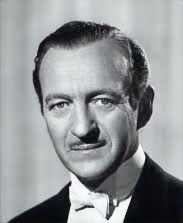


My version
She had first become aware of him, as he followed her every morning in his Jeep when she walked from the hotel where she lived to the office. That is what today we call stalking, but my mother seemed to be flattered by it. In the end her elderly French boss, Monsieur Mouiller, a father figure for my mother, took pity on them, and told her to invite him over to the hotel for dinner, apparently repressing his innate French antipathy for the Brits. The dinner was a success. My father charmed them both with his sardonic sense of humour, and his piano playing. At that time, the hotels and many restaurants had live music. And one of the often told stories was my father tipping the pianist to borrow the piano.
“Once an old American lady went over and tipped him, thinking he was the pianist,” my mother chuckled.
The story I loved most was the one about the morning in Tehran when he burst into their bedroom, brimming with excitement. He told my mother he’d just seen a man in the street wandering around and shouting, “I love music!”
Curious, my mother followed him out to the balcony—and immediately burst out laughing. The man below wasn’t proclaiming his passion for music. He was the quilt maker who came every autumn to fluff the cotton and wool in the quilts. Slinging his fluffer over his shoulder—an object that did, admittedly, look a bit like an instrument—he was simply bellowing his presence to the neighbourhood.
"AY! LAHAF-DOOZI!” he called out.
Literally: “Hey! Quilt-maker!”
I always giggled when I heard the lahaf-doozi shouting his services down the street every autumn. It did sound a little like "I love music."

Smoke Gets in Your Eyes
Music, I believed, was the magic that made them fall in love. My mother told it like a fairytale: the two of them walking in the rain, hand in hand, on their way to the record shop. In my head - so enthralled as I was with musicals (I had seen The Sound of Music seven times) - the crowds stepped aside to let them pass as they walked together under the big umbrella. And they strolled back under the glowing lights of the street lamps, humming along with the velvety voice of Nat King Cole singing When I Fall in Love.
When I was older, I would play their records and try to see it all exactly as she had told , The Great Pretender, Unforgettable, Love Me as Though There Were No Tomorrow, Smoke Gets in Your Eyes—and I imagined them under one umbrella, smiling at each other and humming in perfect harmony, like they knew all the words before the music even started.
It was only many decades later that I discovered that the tears that swelled up in her eyes had other reasons than those memories.